
ADB zet zich in om zijn ontwikkelingslanden te ondersteunen bij het opschalen van klimaatmaatregelen. Als onderdeel van deze verbintenis voert ADB TA 10098-REG uit : Bridging the Gap between Climate Adaptation Planning and Financing, ook bekend als de Climate Adaptation Investment Planning (CAIP) TA. De CAIP TA is gericht op het verbeteren van de capaciteit van ontwikkelingslanden om investeringsprioriteiten voor klimaatadaptatie te identificeren en zo de financiering voor aanpassing en veerkracht te katalyseren. De TB levert drie resultaten: (i) ontwikkelde investeringsplannen voor klimaatadaptatie; (ii) verbeterde beoordeling van projecten voor klimaatadaptatie; en (iii) versterkte regionale kennis over investeringsplanning voor klimaatadaptatie.

De CAIP TA past een vijfstappenproces toe voor investeringsplanning met het oog op klimaatadaptatie: (i) evaluatie van de context van het land en de sector, met inbegrip van nationale ontwikkelingsplannen en -strategieën, klimaatbeleid met inbegrip van het Nationaal Aanpassingsplan (NAP), de Nationaal Bepaalde Bijdrage (NDC) of gelijkwaardige aanpassingsplannen; (ii) een meer gedetailleerde klimaatdiagnose voor geselecteerde nationale aanpassingsprioriteiten; (iii) prioritering van aanpassingsinvesteringen; (iv) koppeling met systemen voor openbaar financieel beheer; en (v) identificatie van geschikte financieringsmogelijkheden. De CAIP TA brengt verschillende relevante ministeries samen, met name het ministerie van Financiën en Planning, het betreffende sectorministerie en het milieuministerie. Bovendien werkt het implementatieproces nauw samen met relevante ontwikkelingspartners die actief zijn op het vlak van aanpassing in het land, de privésector en maatschappelijke organisaties.

FutureWater werd door ADB ingeschakeld om de investeringsplannen voor klimaatadaptatie en de onderliggende klimaatrisico- en adaptatiebeoordelingen (CRA’s) te ontwikkelen voor geselecteerde stroomgebieden in Laos en Oost-Timor. Zowel de CRA’s als de investeringsplannen worden benaderd vanuit een multisectoraal perspectief en houden zich sterk aan de principes van IWRM. Er wordt gebruik gemaakt van watervoorraadmodellering (WEAP) om de vraag naar en het aanbod van water in een geïntegreerd kader in verschillende scenario’s met elkaar in verband te brengen, naast het uitgebreid in kaart brengen van klimaatgevaren, blootstelling en kwetsbaarheid in de studiegebieden, waarbij gebruik wordt gemaakt van een combinatie van geavanceerde mondiale gegevens en instrumenten en lokaal verkregen informatie. De investeringsplannen omvatten het in kaart brengen en beoordelen van de huidige en geplande investeringen binnen de stroomgebieden, met inbegrip van op de natuur gebaseerde oplossingen en groen-grijze infrastructuur, gevolgd door een identificatie van aanpassingsmogelijkheden en daaropvolgende prioritering. De resultaten van het CAIP-proces voor de Democratische Volksrepubliek Laos en Oost-Timor zullen naar verwachting de nationale aanpassingsprioriteiten van het land omzetten in concrete, investeringsklare plannen en de benodigde financiering voor de implementatie ervan veiligstellen.

The GEF / UNDP / ASEAN Project on Reducing Pollution and Preserving Environmental Flows in the East Asian Seas through the Implementation of Integrated River Basin Management (IRBM) in the ASEAN Countries is a 5-year project (2023-2027) with the goal of establishing functional IRBM mechanisms in seven priority river basins / sub-basins / watersheds in six ASEAN Member States, to reduce pollution, sustain freshwater environmental flows and adapt to climate change vulnerabilities. The Project is designed to improve governance and management arrangements in IRBM and accelerate the required changes in the six AMS in support of national priorities, objectives and commitments to global sustainable development targets using the Source to Sea (S2S) framework. The PEMSEA Resource Facility (PRF), which serves as the Project Implementing Partner, hosts the Regional Project Management Unit (RPMU). It works in collaboration with National and Local Government Partners and River Basin Organizations.

Component 1 of the Project focuses on the conduct of a baseline assessment of the S2S management continuum with a targeted outcome of improving understanding of governance, socioeconomic, ecological conditions, gaps and needs of priority river basins / sub-basins and coastal areas. This will be achieved through the establishment of the State of River Basin (SORB) reporting system to consolidate information coming from administrative, social, economic and environmental sectors. As an input to the SORB baseline reporting, it is required to complete a comprehensive assessment of competing uses and users of water as a consequence of existing and future water uses and their implications on the water / energy / food / ecosystem (WEFE) security nexus in the priority river basins.

FutureWater is providing this assessment of the WEFE security nexus through review of existing knowledge and literature, stakeholder consultations, as well as tailoring and applying its REWEFe toolkit for nexus analysis to seven river basins in six countries of Southeast Asia: Cambodia, Indonesia, Lao PDR, Malaysia, Philippines and Viet Nam.

The UNDP is implementing the project “Conservation and sustainable management of lakes, wetlands, and riparian corridors as pillars of a resilient and land degradation-neutral Aral basin landscape supporting sustainable livelihoods” to enhance the resilience of the ecosystems and livelihoods in Lower Amudarya and Aral Sea Basin (LADAB) through land degradation neutrality (LDN) compatible integrated land-water management.

This assignment contributes to water allocation analysis and the development of water supply scenarios for irrigated agriculture and biodiversity conservation reports. The services consist in:

  1. Consulting with project experts, government agencies, local communities, and other relevant stakeholders
  2. Develop a hydro-economic water allocation model for the lower Amu Darya basin using WEAP
  3. Explore different scenarios for irrigated agriculture and biodiversity conservation, considering climate change, to strike a balance between sustainable agricultural practices and conservation of biodiversity and ecosystems and (iv) build capacity and support project experts and relevant stakeholders on water allocation analysis and modelling.
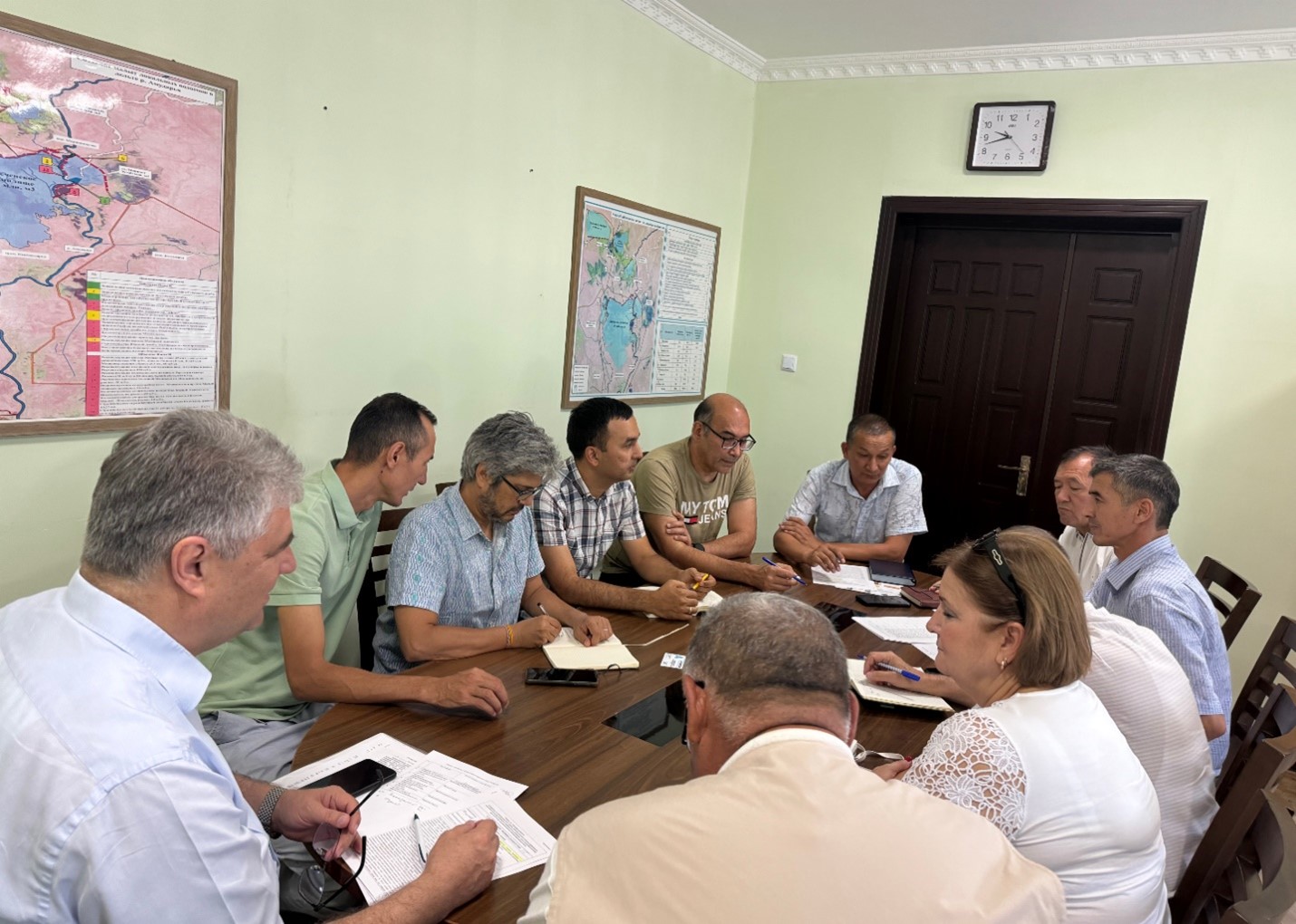
Stakeholders consultation in Nukus, Uzbekistan

Uzbekistan is highly sensitive to climate change which will cause changes in the water flows and distribution: water availability, use, reuse and return flows will be altered in many ways due to upstream changes in the high mountain regions, but also changes in water demand and use across the river basin. The resulting changes in intra-annual and seasonal variability will affect water security of Uzbekistan. Besides, climate change will increase extreme events which pose a risk to existing water resources infrastructure. An integrated climate adaptation approach is required to make the water resources system and the water users, including the environment, climate resilient.

This project will support the Ministry of Water Resources (MWR) of Uzbekistan in identifying key priorities for climate adaptation in the Amu Darya river basin and support the identification of investment areas within Amu Darya river basin. The work will be based on a basin-wide climate change risk assessment as well as on the government priorities with an explicit focus on reducing systemic vulnerability to climate change.

The project will undertake:

  • Climate change risk analysis and mapping on key water-related sectors, impacts on rural livelihoods, and critical water infrastructures.
  • Climate change adaptation strategic planning and identify barriers in scaling up adaptation measures at multiple scales with stakeholder consultation and capacity building approach.
  • Identification of priority measures and portfolios for integration into subproject development as well as for future adaptation investment in the Amu Darya river basin. The identification will cover shortlisting of potential investments, screening of economic feasibility, and potential funding opportunities.

FutureWater leads this assignment and develops the climate risk hotspot analysis, and coordinates the contribution of international and national experts, as well as the stakeholder consultation process.

The “Integrated Strategic Water Resources Planning and Management for Rwanda” consultancy project will assess and evaluate the availability and vulnerability of the country’s water resources up to around 2050 taking climate change into consideration.

Based on this, prioritization of investment options in grey and green infrastructure will take place, in order to formulate water resources investment plans. A revised water resources policy will be prepared that is in line with water security targets and SDG 6.

In more detail, the hydrological modelling assessment will result in update water accounts per sub-catchment up to 2050. Field work for assessing groundwater resources in key areas across the country is also performed. A detailed water allocation assessment will be performed using a water resources system model (WEAP), addressing water needs for the various users up to 2050. Water allocation plans will be developed from this modelling work, incorporating stakeholder inputs.

Then, a scenario analysis is performed to evaluate the potential of additional storage in the landscape: grey (reservoirs) and green (through Nature-based Solutions). This analysis will be complemented by field work and a pre-feasibility analysis will be performed on the prioritized options. A SWOT analysis will then lead to a number of possible flagship projects which of which a concept note is prepared.
Support to the revised national policy for water resources management will also be provided by defining new policy statements and actions informed by the results from the previous tasks and developing a new water resources policy that will guide the country towards achieving the NST1 and Vision 2050 targets.