
Binnen 3POLE4FOOD draagt FutureWater bij aan de beoordeling van de langetermijngevolgen van klimaatverandering voor de waterbeschikbaarheid en de gewasproductie in belangrijke Aziatische stroomgebieden. Het project combineert modellering van berghydrologie met modellering van stroomafwaartse hydrologie en gewasproductie om beter te begrijpen hoe veranderingen in sneeuw, gletsjersmelt, neerslag en temperatuur de irrigatiewatervoorziening en de landbouwproductie beïnvloeden.

FutureWater leidt belangrijke technische activiteiten met betrekking tot klimaatforcering, biascorrectie van meteorologische datasets en het genereren van klimaatveranderingsscenario’s. Samen met Hydrominds en de Universiteit van Wageningen voeren we glacio-hydrologische modellering uit en analyseren we de waterverbindingen tussen stroomopwaartse en stroomafwaartse gebieden. Met behulp van het SPHY-model worden historische en toekomstige afvoeren uit berggebieden gesimuleerd, inclusief de bijdragen van neerslag, smeltwater uit sneeuw en gletsjers. Deze resultaten worden gekoppeld aan het LPJmL-model om de waterbeschikbaarheid stroomafwaarts, de irrigatiebehoefte, de gewasopbrengsten en de waterproductiviteit van gewassen te beoordelen onder toekomstige klimaat- en sociaal-economische scenario’s.

Het project biedt een wetenschappelijke basis voor het identificeren van risicogebieden en het inzichtelijk maken waar landbouwsystemen kwetsbaarder kunnen worden voor veranderingen in de watervoorziening uit berggebieden. Door klimaat, hydrologie en voedselproductie met elkaar te verbinden, ondersteunt 3POLE4FOOD een op bewijs gebaseerde planning voor veerkrachtige stroomgebieden en duurzame voedselsystemen in Azië.
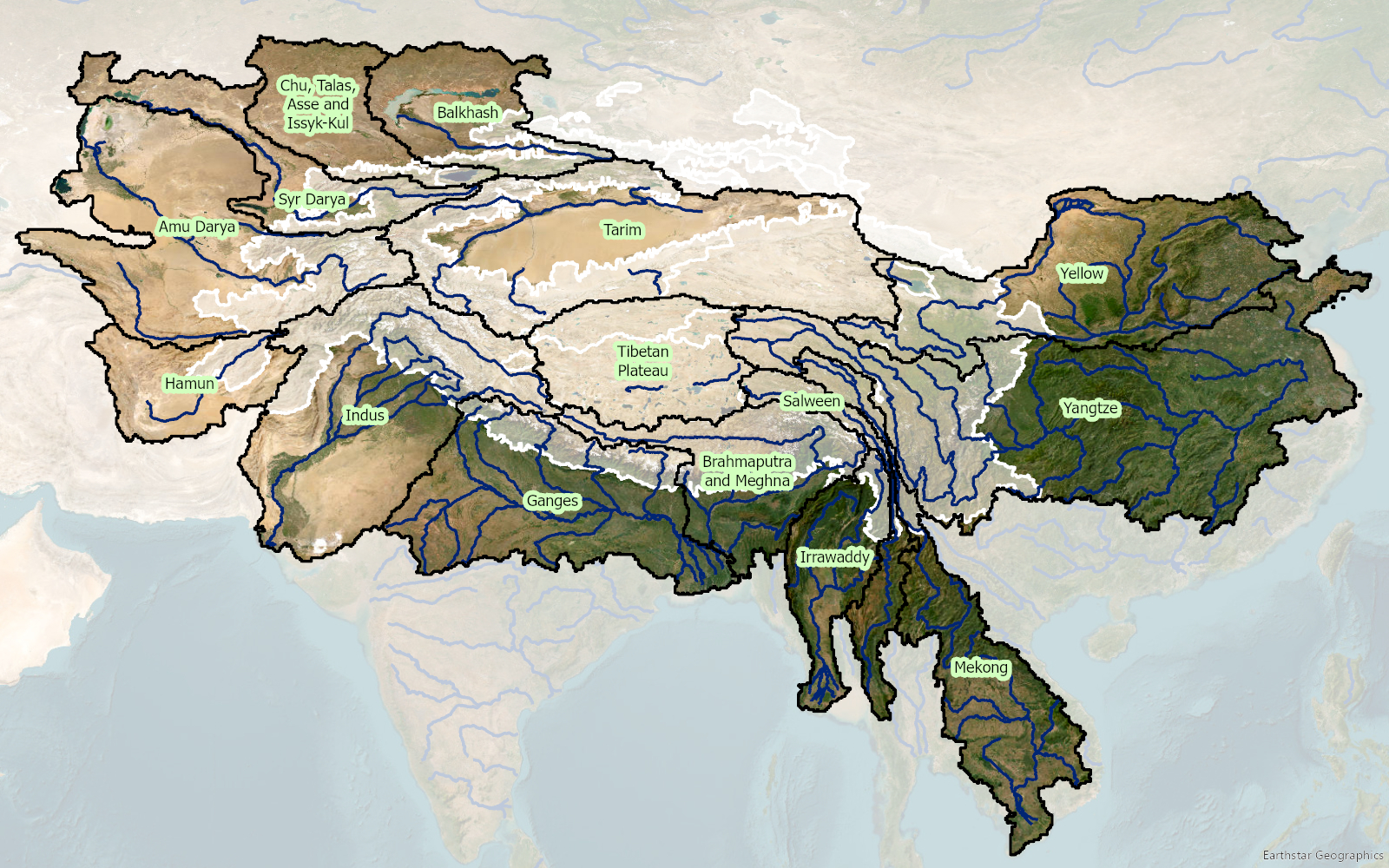
Stroomgebieden die hun oorsprong vinden in de hoge bergen van Azië en die deel uitmaken van het 3POLE4FOOD-project. De witte veelhoek geeft de delen in de hoge bergen aan.

De beoordeling bood een gestructureerde analyse van de huidige en toekomstige klimaatrisico’s voor het bredere watervoorzieningssysteem en voor belangrijke infrastructuuronderdelen, waaronder waterzuiveringsinstallaties, transportleidingen, waterdistributiecentra, slimme waterbeheersystemen en laboratorium- en IT-faciliteiten. Bijzondere aandacht ging uit naar de waterzuiveringsinstallatie van Kampyrravat en de bijbehorende transportinfrastructuur in Andijan, de transportleiding tussen Kungrad en Muynak, en de waterzuiveringsinstallatie van Tuyamuyun in Karakalpakstan. Daarbij werd ook gekeken naar de rol van verbeterde monitoring, telemetrie, SCADA-systemen en gemeten gebieden bij het versterken van de operationele veerkracht onder toenemende klimaatvariabiliteit.

FutureWater analyseerde klimaatrisico’s die relevant zijn voor het projectgebied, waaronder overstromingen, hittegolven, droogte en waterschaarste, door regenval veroorzaakte aardverschuivingen, bosbranden, verzilting van het grondwater en seismische risico’s. De beoordeling combineerde klimaatindexanalyse met blootstellings- en kwetsbaarheidsscreening op componentniveau om vast te stellen hoe verwachte veranderingen in temperatuur, extreme neerslag, opeenvolgende droge dagen en langdurige seizoensgebonden afvoer de beschikbaarheid van water, de zuiveringsprestaties, de betrouwbaarheid van de infrastructuur en de continuïteit van de dienstverlening zouden kunnen beïnvloeden.

De resultaten werden gebruikt om klimaatadaptatiemaatregelen binnen het projectontwerp te definiëren en te rechtvaardigen. Deze omvatten overstromingsbestendige locatiekeuze en verbeteringen aan de afwatering, hittebestendige materialen en bescherming van blootgestelde infrastructuur, erosiebescherming langs pijpleidingcorridors, extra opslag- en operationele maatregelen voor droogteperiodes, verbeterde monitoring van de waterkwaliteit en slimme waterbeheersystemen om niet-inkomsten genererend water te verminderen en een snelle respons te ondersteunen tijdens klimaatgerelateerde verstoringen. De beoordeling droeg ook bij aan de rechtvaardiging van de klimaatfinanciering van het project, waaronder de identificatie van aanpassingsrelevante investeringen in overeenstemming met de richtlijnen van de ADB en multilaterale ontwikkelingsbanken.

Door dit werk heeft FutureWater geholpen de klimaatgerelateerde onderbouwing van een grote investering in de watersector in Oezbekistan te versterken. De beoordeling ondersteunt de ontwikkeling van betrouwbaardere, efficiëntere en klimaatbestendige drinkwatervoorzieningen voor gemeenschappen in Andijan, Ferghana en Karakalpakstan, en draagt tegelijkertijd bij aan de waterzekerheid op de lange termijn onder toenemende klimaatstress.

The Central Asia Regional Economic Cooperation (CAREC) Program is a partnership of 11 countries from Central Asia, South Asia, the Caucasus, as well as Mongolia and the People’s Republic of China and works to increase regional cooperation to help the region shift to low carbon development pathways and build resilience against climate induced hazards. ADB hosts the CAREC secretariat and helps to facilitate projects that deliver regional benefits.

In 2017, CAREC introduced agriculture and water as a new pillar under the CAREC 2030 strategy to provide a conducive and trusted platform to foster regional cooperation and integration on water security. The water pillar was established in 2020 and its scope was devised in 2022. Since then, a number of activities and consultations with CAREC countries have been undertaken including provision of a long list of potential regional projects that could be financed by ADB.

In this project prefeasibility studies will be conducted for three selected priority projects:

  1. Climate change adaptation through improving irrigation efficiency in the Aral Sea Basin
  2. Climate Resiliency of Bakhri Tojik reservoir for improved irrigation and energy supply
  3. Joint Automated Water Metering System in the Aral Sea Basin

The prefeasibility studies entail:

  • Technical, financial, economic, poverty and social analysis.
  • Environment, social, and indigenous people’s safeguards assessments.
  • Climate change assessments.
  • Financial management and procurement capacity assessments; and
  • Institutional set-up and project implementation arrangements.

For these prefeasibility studies FutureWater conducts the climate risk assessment.

Uzbekistan is one of the fastest-growing economies in Central Asia, driving a steady rise in energy demand. However, the country faces significant power shortages due to increasing consumption, declining efficiency of aging power plants, and mounting climate pressures, particularly in regions like Tashkent, Samarkand, and Sirdarya. In response, Uzbekistan is prioritizing renewable energy development, especially solar power, to reduce its reliance on fossil fuels. With its abundant sunlight, the country is well-positioned to harness solar energy, and several large-scale photovoltaic (PV) projects are currently in progress.

With the support of the Asian Development Bank, Uzbekistan aims to strengthen energy security and promote environmental sustainability by developing three solar PV plants (100 MW, 400 MW, and 500 MW), two substations, two battery energy storage system (BESS) facilities, and associated transmission lines across Samarkand, Bukhara, Jizzakh, Sirdarya, and Tashkent provinces. To identify the exposures and vulnerabilities of these project components to potential climate risks, FutureWater will utilize advanced downscaled Coupled Model Intercomparison Project Phase 6 (CMIP6) ensembles, along with relevant hazard data and local information, to conduct a rapid Climate Risk Assessment (CRA). The insights gained will enable the Asian Development Bank (ADB) to implement effective adaptation measures and ensure climate-resilient development.

The UNDP is implementing the project “Conservation and sustainable management of lakes, wetlands, and riparian corridors as pillars of a resilient and land degradation-neutral Aral basin landscape supporting sustainable livelihoods” to enhance the resilience of the ecosystems and livelihoods in Lower Amudarya and Aral Sea Basin (LADAB) through land degradation neutrality (LDN) compatible integrated land-water management.

This assignment contributes to water allocation analysis and the development of water supply scenarios for irrigated agriculture and biodiversity conservation reports. The services consist in:

  1. Consulting with project experts, government agencies, local communities, and other relevant stakeholders
  2. Develop a hydro-economic water allocation model for the lower Amu Darya basin using WEAP
  3. Explore different scenarios for irrigated agriculture and biodiversity conservation, considering climate change, to strike a balance between sustainable agricultural practices and conservation of biodiversity and ecosystems and (iv) build capacity and support project experts and relevant stakeholders on water allocation analysis and modelling.
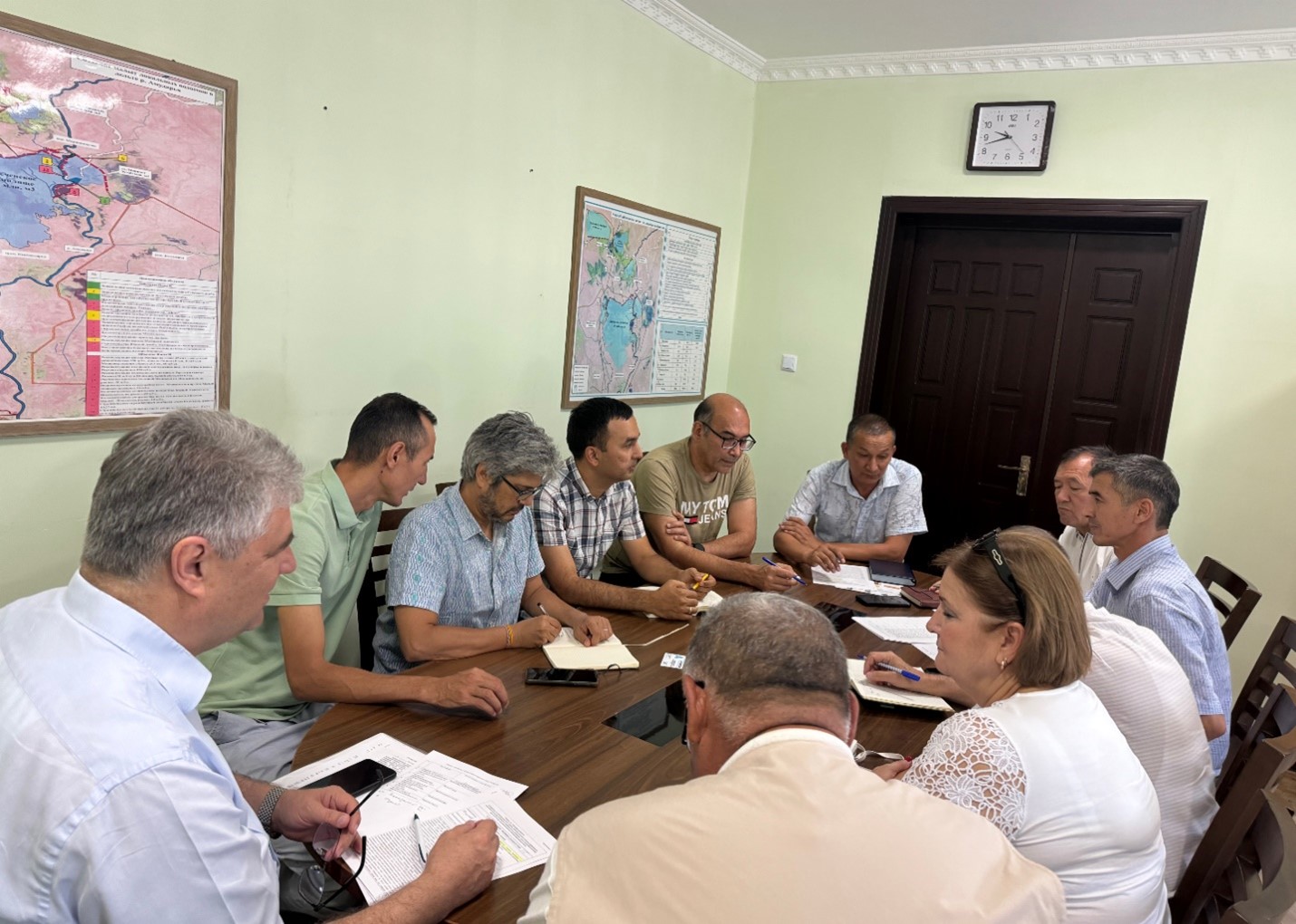
Stakeholders consultation in Nukus, Uzbekistan

The project prepares robust climate mitigation and adaptation pipelines aligned with the Paris Agreement and responsive to DMCs climate change priorities. The TA will support interventions on departmental, sectoral and country levels with key activities including development of a regional strategy, upstream climate assessments, climate pipeline development, government dialogues and capacity building. As part of this project, FutureWater conducts a regional climate risk assessment for ten countries. This includes an assessment of baseline and future climate hazards, exposure and vulnerability and addressing sectoral impacts and adaptation options for a wide range of sectors. In addition country profiles summarizing climate risks for the ten countries are generated. The reginal climate risk assessment feeds into the climate strategy.

With a target to increase the gross domestic product from $70 billion in 2021 to $160 billion by 2030, the Government of Uzbekistan is taking steps to ensure that it will be able to meet the spike in electricity demand which is expected to double by 2030. Initiatives include installing an additional 17 gigawatts capacity to the existing available capacity of 12.9 GW, out of which 8 GW will be from renewable energy projects. Currently, the distribution system in Uzbekistan comprises of more than 260,000 kilometers of 0.4-110 kV networks, 1,655 substations and more than 86,000 transformer points. However, more than 50% of the lines have been operational for 30 years and 30% of the substation transformers are in dire need of rehabilitation. Therefore, the Asian Development Bank is working closely with the Joint Stock Company Regional Electric Power Networks (JSC REPN) to: i) Rehabilitate and modernize the distribution substations, ii) Rehabilitate associated distribution lines, and iii) Enhance the institutional capacity for financial sustainability and climate resiliency.

These rehabilitation efforts will also take into account and address the growing impacts of climate change in the region. For this, FutureWater has been assigned to carry out a climate risk and adaptation assessment (CRA). FutureWater will make use of state-of-the-art downscaled Coupled Model Intercomparison Project Phase 6 (CMIP6) ensembles, and other relevant hazards and local information to develop this CRA. Insights from the CRA will be used to devise adaptation strategies. Additionally, FutureWater will be reviewing the existing meteorological monitoring network and recommending additional potential monitoring sites for improved surveillance in the country. To further assist the Government of Uzbekistan actualize its second Nationally Determined Contribution (NDC) agenda which seeks to reduce greenhouse gas (GHG) emissions per unit of GDP by 35% (compared to the level in 2010), by the year 2030, FutureWater will also develop a GHG account and prepare a Paris Agreement alignment assessment.

In de afgelopen decennia is efficiënt waterbeheer een belangrijk onderdeel geweest van het waterbeleid van de EU. Dit onderwerp krijgt hernieuwde aandacht in de herziene EU-aanpassingsstrategie van 2021, waarin de noodzaak van een kennisgestuurde benadering van waterbesparende technologieën en instrumenten, zoals efficiënte toewijzing van watervoorraden, wordt benadrukt. Het speciale IPCC-rapport over oceanen en de cryosfeer in een veranderend klimaat (2019) wijst op de combinatie van waterbeheer en klimaatrisico’s als potentiële oorzaken van spanningen over schaarse watervoorraden binnen en over landsgrenzen heen, met name bij concurrerende vraag tussen waterkracht en irrigatie in grensoverschrijdende gletsjer- en sneeuwgevoede stroomgebieden in Centraal-Azië.

De innovatieve aanpak van WE-ACT bestaat uit twee complementaire innovatieacties: de eerste is de ontwikkeling van een gegevensketen voor een betrouwbaar waterinformatiesysteem, dat op zijn beurt de tweede mogelijk maakt, namelijk het ontwerp en de uitrol van een beslissingsondersteunend systeem (DSS) voor de toewijzing van watervoorraden. De gegevensketen voor het betrouwbare waterinformatiesysteem bestaat uit realtime in-situ hydrometeorologische en glaciologische monitoringtechnologie, modellering van het watersysteem (inclusief modellering van wateraanbod en -vraag en watervoetafdrukanalyses) en gletsjermassabalans, datawarehousetechnologie en machine learning.

De uitrol van het DSS voor klimaatrisicogestuurde toewijzing van watervoorraden bestaat uit analyses van belanghebbenden en instellingen, methoden voor waardebepaling van water, de opzet van het waterinformatiesysteem om een gebruiksvriendelijke interface mogelijk te maken, ontwikkeling van gebruiksscenario’s voor watertoewijzing en feedback over watergebruik via nationale beleidsdialogen.

Het werk van FutureWater binnen de WE-ACT-studie zal zich richten op het inschatten van de waterbehoefte en watervoetafdrukken van de verschillende gebruikers en activiteiten binnen het Syr Darya-stroomgebied. Daarom zullen de effecten van watertoewijzing op watervoetafdrukken, onvervulde watervraag en schendingen van milieustromen worden geëvalueerd met behulp van een reeks hydrologische modellen, zoals SPHY en Water Allocation-modellen (WEAP). Dit zal worden gedaan voor zowel de huidige situatie als toekomstige scenario’s.

Voor meer informatie kunt u de WE-ACT projectwebsite bezoeken.

With over 1,850 km of 500kV lines, 6,200 km of 220kV lines and 15,300 km of 110kV lines, the power transmission system in Uzbekistan is facing challenges with respect to deteriorating infrastructure and unreliable power supply. To address these issues, the Asian Development Bank (ADB) is assisting the Government of Uzbekistan through the “Uzbekistan Power Transmission Improvement Project” which aims to: i) improve the power transmission network capacity and reliability in the northwest region of the country, ii) reduce transmission losses, and iii) improve the operational efficiency of the power sector. This will be done through the i) construction of a new 220kV single-circuit overhead transmission line spanning over 364 km, ii) expansion, rehabilitation, and construction of 3 substations and iii) capacity building and institutional development.

Additionally, given the growing impacts of climate change in the region, FutureWater has been assigned to carry out a climate risk and adaptation assessment for 12 transmission lines and 2 substations in the country. FutureWater will make use of state-of-the-art downscaled Coupled Model Intercomparison Project Phase 6 (CMIP6) ensembles, and other relevant hazards and local information to develop this CRA. The insights from this assessment will enable ADB to justify climate financing for further enhancing the climate resilience of the grid system. Moreover, through the adoption of climate-resilient technologies and adaptation measures based on the climate risk assessment, the country will be able to cut down on their GHG emissions and ensure uninterrupted power supply in light of a changing climate. This will be complimented by deriving adaptation costs to justify the need for climate financing. In addition, FutureWater will also be reviewing the existing meteorological monitoring network and recommending additional potential monitoring sites for improved surveillance in the country.

Uzbekistan is highly sensitive to climate change which will cause changes in the water flows and distribution: water availability, use, reuse and return flows will be altered in many ways due to upstream changes in the high mountain regions, but also changes in water demand and use across the river basin. The resulting changes in intra-annual and seasonal variability will affect water security of Uzbekistan. Besides, climate change will increase extreme events which pose a risk to existing water resources infrastructure. An integrated climate adaptation approach is required to make the water resources system and the water users, including the environment, climate resilient.

This project will support the Ministry of Water Resources (MWR) of Uzbekistan in identifying key priorities for climate adaptation in the Amu Darya river basin and support the identification of investment areas within Amu Darya river basin. The work will be based on a basin-wide climate change risk assessment as well as on the government priorities with an explicit focus on reducing systemic vulnerability to climate change.

The project will undertake:

  • Climate change risk analysis and mapping on key water-related sectors, impacts on rural livelihoods, and critical water infrastructures.
  • Climate change adaptation strategic planning and identify barriers in scaling up adaptation measures at multiple scales with stakeholder consultation and capacity building approach.
  • Identification of priority measures and portfolios for integration into subproject development as well as for future adaptation investment in the Amu Darya river basin. The identification will cover shortlisting of potential investments, screening of economic feasibility, and potential funding opportunities.

FutureWater leads this assignment and develops the climate risk hotspot analysis, and coordinates the contribution of international and national experts, as well as the stakeholder consultation process.
